

Origin stories 101
How origin stories shape who we are and what we become

Hi there! You’re reading the Bonfire newsletter from Kevan Lee & Shannon Deep. Each week, we highlight learnings from our experience as in-house marketers turned agency owners who think a lot about creativity, our relationship to work, and how all of that impacts our identities. We’ll also feature insights from our digital community of super smart folks (which you’re welcome to join).
Wishing you a great week!
How to craft your origin story
I am in the middle of re-watching all of the Marvel superhero movies—in chronological order this time, so I can tell what’s going on—which means I am presently steeped in comic book lore: Captain America as a virtuous skinny kid, Thor and Loki as bickering brothers, Tony Stark as a hotshot tech founder (I wonder who his VP of Marketing was?).
Marvel is really good at storytelling.
And their movies, in particular, are great at the origin story.
The origin story is a narrative that explains who you are, combining context and details with meaning and purpose.
A superhero’s origin story is critical to their being able to resonate with an audience and ground future action in meaning, purpose, and intent. Marvel’s origin stories come in all shapes and sizes, too.
For every Natasha Romanoff / Black Widow, there is a Matter-Eater Lad, a superhero from an alien race whose defining power is the ability to eat literally anything: metal, glass, concrete, weapons.
For every Peter Parker / Spider-Man, there is a Spider-Ham, a spider bitten by a radioactive pig, which turned the spider into a super pig who retained the powers of a spider.
The origins of some of our most well-known brands and products also run the gamut; a business’s beginnings can take all shapes and forms. Some of the more remarkable ones include:
Slack started as an internal chat tool for a video game development team. No one wanted the video game they made (Glitch).
Twitter was a discarded side project at a struggling podcast company, Odeo.
Ben & Jerry’s is an ice cream brand, but the founders originally wanted to do bagels, not ice cream. The equipment to make bagels was too expensive.
Craigslist began as a simple email list Craig Newmark sent to friends to share local events. It wasn’t intended to be a company, product, or platform at all.
But if we were to stop at just the trivia of these stories, we’d miss the heart-and-soul impact of what an origin story truly represents. At Bonfire, we believe that stories make meaning—for business, sure, but also for us human people. Stories reveal who we are and how we tick. Origin stories especially. So let’s explore this together! We’ll get to an origin story template further below, but first, let’s see why these stories matter in the first place.
Why an origin story matters
Businesses go bananas for differentiation. We’ve worked with dozens of these companies through our agency work at Bonfire. Take any commoditized product category—email marketing software, CRMs, design tools, and especially AI products—and it’s remarkable how quickly a sales pitch devolves into a side-by-side feature comparison: “Who has which features, and how much do those features cost?” Spoiler alert: Feature differentiation will never last. Price can always be disrupted. So rather than differentiate on the particulars of what you sell and how you price, we encourage companies to differentiate on who you are.
No one will be able to match your origin story.
Why do origin stories matter to businesses? They create differentiation by forcing you to articulate why you do what you do. (This is the heart of brand marketing, which we also just so happen to believe is THE biggest thing businesses can do to survive and thrive these days.)
But it’s not every day that us regular humans are waking up in a cold sweat, shouting, “But how can I differentiate myself?”
Where else might origin stories come into play for us?
One of the most obvious places is the job search. When I was interviewing for roles back in the day, it took me six months at least to hone my origin story into something that felt true, cohesive, and helpful for explaining to others why I was here and what I was looking for next. But it’s not just the job market where an origin story can shine. Here are a few other realms where a story like this can be helpful:
Meeting new people
Choosing your next creative project
Career pivots or reinvention moments
Leaning in to leadership or management roles
Recovering from burnout or taking a sabbatical
Certainly, an origin story can be good for explaining your unique perspective, your one-of-a-kind-ness. Every origin story is unique and unmatchable by anyone else; we are all snowflakes. But let’s take this one level deeper into what an origin story can do for you.
Origin stories help crystallize your purpose. By going back to the beginning, you can better understand why you’ve taken the paths you have and to see more clearly a throughline of purpose behind your actions.
Origin stories prescribe meaning. Rather than a mishmash of details, an origin story puts the pieces together in a thematic way where every step means something and gets you closer to who you are / where you are today.
Origin stories build connection. Stories, in general, do this. Sharing where you started from can be a sticky way to bring people closer to you, people who have shared your experience or can empathize with where you’ve been.
Origin stories point you in a direction. As you’ll see in the template below, the output of an origin story is a “so what now.” The origins build momentum by clarifying what kinds of problems are worth your energy next.
How to craft your origin story
You can build an origin story in any number of ways, although we will give you one specific formula to try here in a moment. As you’re drafting, keep in mind some things that an origin story doesn’t need to be:
It doesn’t need to be hugely comprehensive. E.g., we don’t need to know the details of what Spider-Ham wanted to be when he grew up.
It doesn’t need to be revisionist history. E.g., we’re not judging Slack’s video game failures, we’re just noticing that these failures played a role.
It doesn’t need to be impressive. In fact, trying to make it impressive often makes it less true.
Your origin story can take many shapes and forms, but in general we wanted to provide a guiding framework to help you think logically through a handful of components that go into your final story.
Below, you’ll find six steps of the origin story creation process, which should give you all the context you need to fill in the template we include at the end.
1. Identify a friction
All good origin stories start with some sort of conflict moment. We’ve written a lot about storytelling frameworks before and how to tell a great story from beginning to end. For origin stories in particular, one of the best places to start is with the “bad stuff”/friction:
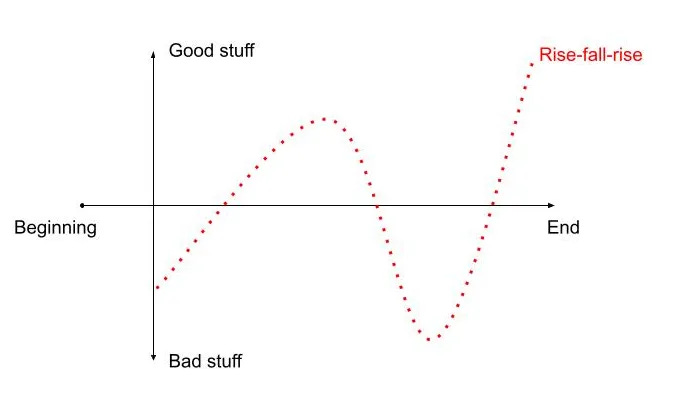
Some questions to consider:
What was nagging at you?
What was it about your situation that felt inefficient or misaligned?
What were you tolerating longer than you should have?
2. Name the constraint
Related to the friction, you might find that there is a larger theme of constraint that is central to your story. Oftentimes this can look like:
Time
Money
Confidence
Permission
For me, I noticed that impostor syndrome and “shoulds” played a huge role in constraining who I wanted to become. This aspect of my origin story could be traced directly to the friction of seeking a promotion or landing a new job. I felt constrained by my own (false) inadequacy.
3. Identify the first small choice you made
As the friction and constraints become clearer, you can start to move your origin story into action mode. Ask yourself, “Because of the friction and constraints, what did I do first?” The answer could be things like a simple experiment you tried, a new side project you kicked off, or even just a conversation you had that got you started on the road to where you are now.
4. Articulate a pattern
At this stage, you can start putting some pieces together of the issues that keep cropping up. You’ve already by this point noticed the friction and constraints that spurred you on. Now it’s time to reflect on the collective meaning behind all the context.
Some questions to ask:
What kept repeating?
What problem followed you from role to role?
What were people consistently asking you for help with?
In past versions of my origin story, I found a pattern of dissatisfaction with the state of in-house marketing roles, a pattern of my failing to bet on myself, a pattern of longing for a job that gave me more creative freedom..
5. Describe the internal shift you made
We’re at the transformation stage now! It’s important here to not merely talk about the external details of what happened to you in the story but to focus instead on the internal change that took place. In particular, you can focus on:
How your thinking changed
What you stopped believing about yourself or about the world
What you trust now that you didn’t trust before
6. Name what you’re oriented toward now
And finally, we arrive at your current focus. Given the friction and constraint and choices and patterns, where has this shift brought you? Keep in mind: Frame your answer as an orientation, not an identity. Rather than a statement like “Now, I am X,” instead think about your orientation in these ways:
“I’m drawn to…”
“I tend to work best when…”
“I’m interested in problems that…”
This way you still have the flexibility to think of yourself in all sorts of different ways while specifically calling out the things that draw you.
When you’re done with these steps, you should have the context to go and create your origin story from beginning to end. Here’s a simple template you can use.
I kept running into ___, even when I changed roles.
I didn’t plan to pivot, but I started experimenting with ___.
Over time, I noticed a pattern: ___.
What changed wasn’t just what I do, but how I think about ___.
Now, I’m oriented toward work that ___.
It’s okay if your origin story changes
Your origin story is not canon in the way that Marvel makes its movies. Sure, you can’t change some of the actual details of your story, but you can certainly change your perspective on the details and the takeaways of what you’ve learned.
You may change your origin story in different contexts. Perhaps you have one origin story for your job search and one for your dating life. Perhaps you have one at work and one with friends. If you’re a business, perhaps there’s one you tell the media and one you tell employees.
You may also see that your origin story changes over time. For one thing, life will keep happening, so you may choose to pick up a new origin story at any new point, or to add context and color to an existing story. But also, you’ll be changing as a person, so your perspective and interpretation of past events may also change. What matters to you may change, so it would make sense that your story would change, too.
Tell us about your origin story
We’d love to hear from you if you have a story to share, or even if you just want to bounce off some version or draft of your current story. We’re all ears!
Join us in Campout
In Campout, our digital community, we talk about stuff like this on the daily in our channels and a couple times a month in our live events. All supported by exercises and templates to help you craft a career with purpose and intention.
But wait! There’s more…
Wanna hang out in person?
New retreat dates are up! Head to our experiences page to join our next one in April 2026.
Wanna work with us?
If you need help with brand strategy and storytelling, fractional brand and marketing leadership, and bringing your brand strategy to life in impactful ways, send us an email at hello@aroundthebonfire.com to get in touch.
As always, you can find us on LinkedIn, Instagram, and Threads.
bookmarking this as something I ought to go through myself, on a professional level, on a personal level, on a relationships level, on a joy level. super cosy and super warm, love the way you tell this kevan :)
A friend of mine shared your post with me as I'm currently going through a rebrand that requires *a lot* of new copy, stories, all the bits.
God freaking sent. Great exercise, thanks for sharing!