Delete your heroes
On finding inspiration for an experimental life

Hi there! You’re reading the Bonfire newsletter from Kevan Lee & Shannon Deep. Each week, we highlight learnings from our experience as in-house marketers turned agency owners who think a lot about creativity, our relationship to work, and how all of that impacts our identities. We’ll also feature insights from our digital community of super smart folks (which you’re welcome to join).
Wishing you a great week!
I drive Kevan up a wall sometimes frequently with how allergic I am to committing to Just Doing A Business. That doesn’t mean I’m not committed to Bonfire or to our partnership. But it does mean that I’m the obnoxious person ready and willing to burn it all down and start over (and over) until we find the configuration of commercial activities that sits at the optimal crossroads of:
What We Actually Like Doing × What Is Financially Successful × What Is Sustainable
Which basically means I treat everything like an experiment. (This also applies to my personal life, so at least I’m consistent.)
The upside of this experimental attitude is that “failure” barely exists to me. It’s just more information I can use to do better next time. I’ve also worked hard to cultivate the self-trust that I will be ok no matter what happens to me, which softens the stings of all the things that inevitably don’t work out the way I want them to. I like all that. The downside of viewing everything as an experiment is that I have a heaping helping of skepticism of the power of simply powering through a pre-set plan, which is, admittedly, sometimes what is actually called for. Oops.
Relatedly, one of my biggest professional fears is ongoing sacrifice in service of some uncertain far-future payoff—a permutation of the classic trope of working a job you hate for forty years only to drop dead the day before you retire. If you are giving up enjoyment of your Now for your Later, without a clear boundary for when that sacrifice ends, I tend to believe that you’re making a bad bet.
Kevan says his greatest professional fear is being stuck on a treadmill. And in a really important way, that means our fears are aligned: neither of us want to grind away at the soul-crushing monotony of repetitive work with no end in sight. But I’m just now realizing how much I over-indexed on understanding the “running” part of his metaphor at the expense of the other key part: The fact that when you run on a treadmill, you don’t actually go anywhere.
Kevan doesn’t love running, but he hates not moving.
Me? I hate running. And we’ll get there when we get there.
To him, being experimental can feel like starting over, or like the preamble to the real thing. Like ok, we’re experimenting to find The Thing, then we stop experimenting and go do The Thing!
But to me, experiments can feel like The Thing! They make my Now rich and full, even when they don’t “go” anywhere. We’re learning! We’re changing! We’re not making the same mistakes twice! (Mm…we’ll get back to you on that one.)
For a long time, I assumed this was just about personality or workstyle differences. But lately I’ve been wondering, if for me at least, it goes back much further than that. All the way back to childhood.
Experimentation: An origin story
Left turn: I’ve been thinking lately about my relationship to “heroes.”
Maybe things have changed since the ’80s and ’90s, but I remember there being a lot of talk about heroes when I was growing up. Not the comic-book or movie-franchise superhero kind. I mean real people, more in the sense of role models.
Having a hero or a role model seemed to be a recurring theme in kids shows. And I swear Oprah had multiple episodes about meeting your heroes, or celebrating unsung heroes, things like that. Teachers and adults were always asking who our heroes and role models were. Sometimes it was even a school assignment: draw them, research them, write about them, write letters to them. Most kids picked famous people—both contemporary and historical—but plenty chose someone in their family, especially a parent.
Even among us kids, there was a lot of conversation about athletes, actors, artists, and other public figures—scientists, activists, innovators—people who were treated as beacons of inspiration and objects of admiration. It was, and I assume still is, totally normal for kids to plaster their bedroom walls with posters of their role models, and—though it was much harder to do so in the ’90s—eagerly look up all the stats and trivia about them. (Why anyone needed to know Steve Jobs’s or Michelle Kwan’s birthday, I couldn’t tell you.)
There was just a lot of childhood real estate dedicated to this idea, right?!
And I always had this quiet feeling that something was wrong with me, because…I didn’t really have any heroes.
It’s not that there weren’t people I thought were cool, or things people created or achieved that I found admirable and important. And I certainly loved my parents and family. But nobody ever got elevated to mythic status or even role-model level in my mind, and the only poster I ever put up was a print of The Accolade by Edmund Leighton. (Interpret that as you will. 🤷♀️)
This not-having-a-hero-thing wasn’t some kind of conscious resistance. I truly drew a blank whenever I was asked, and still do! Part of it was probably a little-kid defense mechanism along the lines of Hmph, what’s so special about them?! But another part was just a general skepticism of the concept of someone being a hero/role model, which often seemed contingent on inhuman perfection that felt performative and fake to me—even as a kid. Like, no need to go around fawning over fellow colleagues in humanity, you know?
What I’ve realized is that when someone did something impressive or admirable, my reaction was never: I want to be like them. It was always something closer to: I want to try doing something like that. The focus wasn’t the person; it was the action.
Admiring acts > Admiring people
If you admire people, the inspiration can feel distant. Heroes and role models often seem exceptional or singular. If you admire actions, the inspiration becomes more accessible. If someone did it, then it’s a thing that can be done vs. that person did it because they are extraordinary (and I am not).
All this, I suspect, has changed how I move through the world.
Role models are models. They seem to offer a template for how a life is supposed to unfold: Follow this path, make these decisions, emulate this trajectory, and bing bang boom—success! fulfillment! greatness! But if you never really adopt a role model, you don’t inherit a template. So instead of following a set path, you experiment. (See! It all connects!)
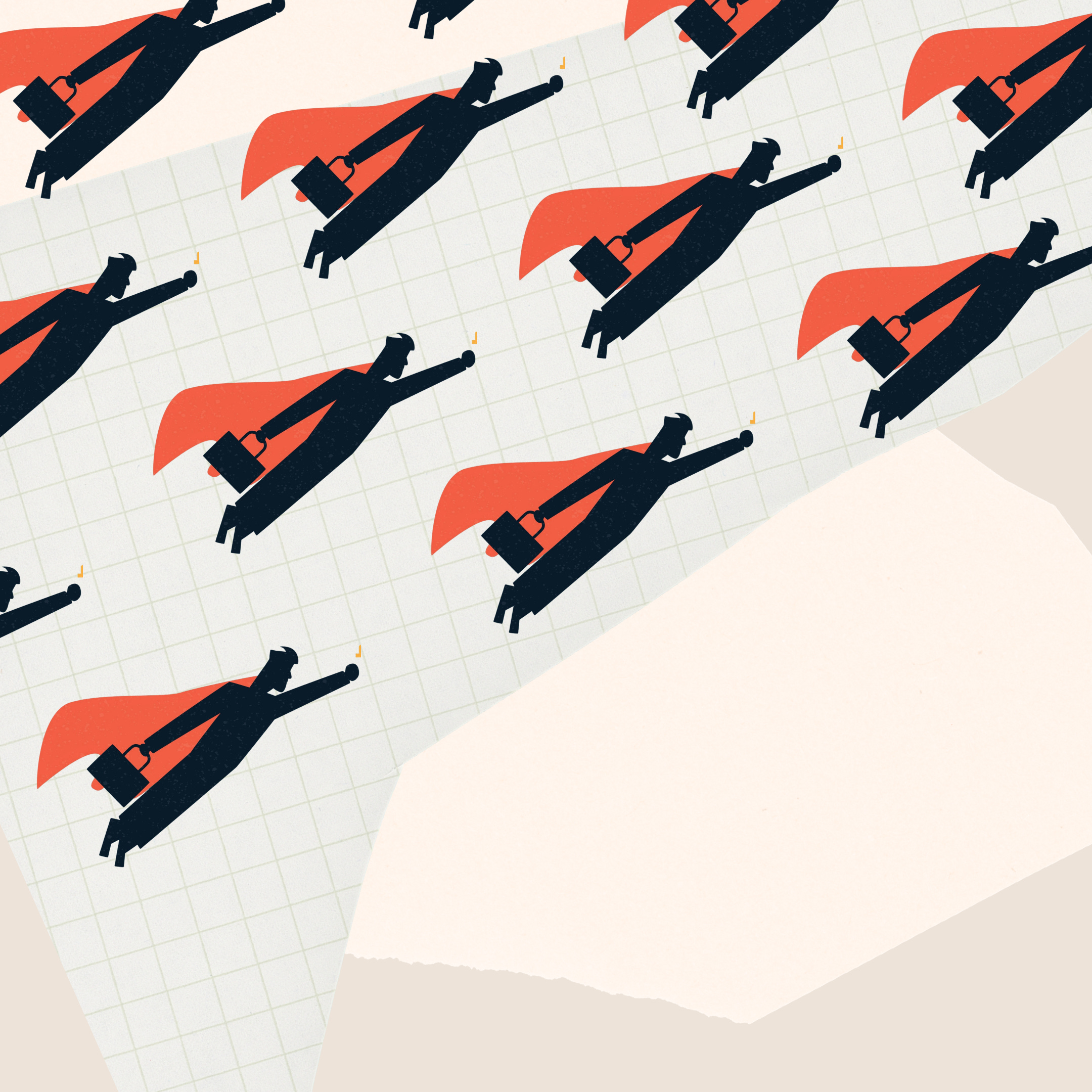
The older I get, the more experience I have in business and especially the startup world where everybody blabs on about playbooks and case studies, the more I suspect modeling either your life or your business after your heroes comes with a major hidden pitfall: survivorship bias.
When we look at famous innovators, artists, founders, athletes, etc., we’re looking at the tiny fraction of people whose stories happened to work out. Their trajectories look coherent in retrospect, like a formula you could follow if you just made the same choices. But for every person whose path worked out, there are thousands who made the same moves and disappeared into obscurity.
Role models make life look like a script, a repeatable process that places the onus on you to follow it closely enough, disregarding the random or luck-based or flat-out-biased factors that contributed to it. And we’re encouraged to think about it this way! At least in the U.S., we lean waaay into the propaganda of meritocracy and exceptionalism. (As a successful actress once said to me: “You can’t listen to statistics—they’re about other people!”)
For me, prioritizing being experimental in my work and life is an acknowledgement that life is less like a script and more like a lab. But you can’t just do whatever the hell you want in the lab! You need to carefully select the right chemical components, you need to design the procedure thoughtfully, do your research, and, importantly, invest a lot of time and energy into testing and learning.
In my last post, I talked about increasing your luck surface, the idea that luck is an essential component to success and while you can’t control it, you can juice your chances that it finds you. While being experimental maybe opens 10 doors instead of actually walking through just 1, you’ve increased your odds of finding The Thing—whatever that is for you—behind one of them.
Over to you…
What’s your relationship like with role models and heroes? Has it changed over time? Has a role model ever steered you wrong or led you to the exact right place? Let us know!
But wait! There’s more…
Wanna hang out in person?
Our next retreat in April 2026 is SOLD OUT! However, you can sign up for the mailing list to find out when the next one is happening.
Wanna work with us?
If you need help with brand strategy and storytelling, fractional brand and marketing leadership, and bringing your brand strategy to life in impactful ways, send us an email at hello@aroundthebonfire.com to get in touch.
As always, you can find us on LinkedIn, Instagram, and Threads.