Hi there! You’re reading the Bonfire newsletter from Kevan Lee & Shannon Deep. If you like the types of things we talk about here, you’ll enjoy our online events and in-person retreats. Interested in our upcoming creative retreats? Details here.

When I was eighteen, I was on the porch of my parents’ house, talking to a family friend my parents’ age. I was telling her that, in addition to studying English, I’d also been accepted into Carnegie Mellon University’s theater conservatory, where I was studying directing.
A look of cringing concern flashed across her face, like I’d just told her I’d decided to cut my own hair or ride a bike blindfolded.
“Theater? But you’re so smart!” she blurted.
Looking back on that interaction 20 years later, there’s a lot I could say about it. About how that comment reveals a whole bevy of beliefs and assumptions about what that particular person valued and didn’t. How those beliefs reflect the general attitude of certain Americans about the arts and the people who participate in them. Generously, I can also see how the comment is a kind of misplaced maternal concern for a young person on the precipice of making a “mistake.”
But really, it’s a comment about wasting one’s potential, isn’t it?
A smart person should be doing a smart person job, which will become a legibly smart person career. To this family friend, that probably meant either something that made a lot of money or helped people in very concrete ways. (She was a medical professional herself.)
The implied corollary to this is that some people have more potential than others, and it would be foolish not to maximize that.
But potential to do what exactly?
Twenty years later. I still think about it.
This idea came up recently in an interview I did with Ambra Hubert for her LinkedIn series “Permission Slips: Real stories of reinvention, risk, and doing life differently.”
One of the questions she asks her interview subjects is:
What rule (spoken or unspoken) did you break?
My response:
If you’re smart and capable, you should care about nurturing and advancing your career as far as you can take it. Otherwise, you’re “wasting” your potential.
I felt myself breaking that rule really acutely when I moved to France, which has a way more relaxed culture around achievement and ambition, then even more acutely when Kevan and I stepped off the startup ladder to launch Bonfire, and even more more acutely as Kevan and I get increasingly clear on what, exactly, we’re trying to achieve with this business. And what we explicitly aren’t.
Anyway, it’s all highlighted just how many problems I have with the concept of potential. Here are my 3 main gripes:
Problem 1: Potential seems to mean production
Normally when we talk about people’s potential, we’re talking about their ability to “succeed,” or to “make an impact.” But we by-and-large define those things by the status they confer and/or the external value they create. Rarely is someone regarded as fulfilling their potential by being an excellent parent or incredible friend, by having a lot of hobbies that they love, a home they are proud of.
We don’t tend to look at people who are simply content and peaceful and say, “Wow! They are living up to their potential!”
Because potential, apparently, is supposed to produce something. Something concrete, measurable, external. Something that other people think is valuable.
But defining our value to the world, to society, to ourselves by what we produce is a one-way ticket to the toxic productivity treadmill. You will never get off the treadmill, because a capitalist, materialist society does not have a functional definition of enough.
And speaking of definitions…
Problem 2: Who’s defining your potential?
We talk not infrequently in this newsletter about creating your own definitions of success, your own definitions of what is meaningful, what is enough. But that’s so much harder than glomming onto the social signals around you or just listening to the influential people in your life. People who almost certainly do love you and want the best for you.
The problem with simply adopting external definitions of your potential is that while others/the world around you are the primary beneficiaries of you living up to your supposed production-based potential, you are the primary beneficiary of your own happiness. So what do you do when those things conflict?
I’m definitely not arguing for some kind of naval-gazey solipsism—we have to live in community, and we have a duty of care to our communities—but rather expressing a skepticism that living up to your potential is ever a fait accompli. Because while you walk this mortal coil, couldn’t you always be doing something else? Couldn’t you always be doing more? And if you aren’t, then is your potential really ever met?
Join our next free online event!
Problem 3: You could…but should you?
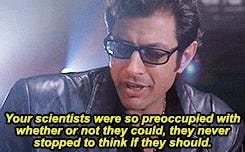
We could all do a lot of things.
I could have stayed at the first agency I worked at and eventually taken over the brand comms team, which is what the CEO told me I had “the potential” for. I could also have gone back to culinary school and become a chef. Or went and got my MFA in playwriting.
Or or or or or…
You probably have a list of 10 things you could have done, too. But like, what’s the game here? What are we maximizing for? The most money? The most prestige? The most obvious path to “making it”?
The thing that will make other people say: “Yes, they met their potential!”?
Most likely, we assume potential is going “far” vs. going “wide,” but what happens when we could go far up multiple ladders? Are we obligated to climb them all? Can we ever maximize our potential if we don’t?
And, most importantly:
Can we ever take a fucking break?
This is maybe my ultimately problem with potential. It is a feast you will never finish. And you’ll just stand at the table, paralyzed and unsatisfied, or you’ll eat until you explode.
Do it for you
Funnily enough, that “But you’re so smart!” comment turned into a performance piece for my directing class later that semester.
I no longer remember the exact prompt from the professor—it might have been to create some kind of artist’s statement of purpose—but I ended up emailing dozens of friends and family and asking them to give me a few sentences of what they believed I was best at. By nature of my request, they were all kind, gave me lots of praise, and expressed high belief in what I could do.
I took all the responses and printed them out, and sat at a table with a pair of scissors in front of me. I began folding up the paper and told my class the story about the family friend and what was on the paper I was folding. And then I started cutting. As I cut, I talked about the kind of person I wanted to be, the kind of art I wanted to make, the stories I believed were important to put into the world.
In the end, I unfolded a set of paper snowflakes made of what other people thought I could do. Beautiful. Delicate. Impermanent. With lots of holes to see myself through.
Over to you…
What’s your relationship with potential like? Have you found the concept motivating? Intimidating? We want to hear about it!
A 5-day retreat in the French countryside to kill your creative procrastination, once and for all.
But wait! There’s more…
Wanna work with us?
If you need help with brand strategy and storytelling, fractional brand and marketing leadership, and bringing your brand strategy to life in impactful ways, send us an email at hello@aroundthebonfire.com to get in touch.
Wanna hang out in person?
We do in-person retreats…and our 2027 calendar is live! Browse all the details here, or sign up for the mailing list to find out when we have new ones to offer.
Wanna hang out online?
We’ve got a bunch of digital events on the calendar. We’d love to see you there.
As always, you can find us on LinkedIn, Instagram, and Threads.