Hi there! You’re reading the Bonfire newsletter from Kevan Lee & Shannon Deep. Each week, we highlight learnings from our experience as in-house marketers turned agency owners who think a lot about creativity, our relationship to work, and how all of that impacts our identities.
Wishing you a great week!

I recently came across this TikTok by Kristen Lowe, which led me to this post on her Substack. And I just had to talk about it!
(Note: You can now come to our free event about this topic with Kristen!)
Lowe outlines a paradigm-shifting way to think about the cost of success—success meaning achieving a stated goal at a high level, not just making a lot of money or sitting at the top of the career ladder. Generally speaking, we believe that success “costs” time and effort, right? We understand that it could also cost money, like an upfront or continued investment in a business or in education (which is also time and effort!).
We get mad when we see people succeeding without spending these obvious “currencies,” because that means they (supposedly) didn’t earn or deserve them. Lowe highlights influencers as an obvious example of this: They’re getting lucrative brand sponsorships and podcasts and book deals, walking red carpets…and for what? Sitting in their rooms, posting on social media?
But as Lowe beautifully states:
Success is always paid for in full — just not always in the currency people can see. …when we consider how people are paying for their dreams, not just how much, our imaginative aperture is dangerously narrow.
- The Currencies of Success, Kristen Lowe
Every dream costs some combination of currencies, but only some of them are time and effort and cold hard cash. That combination differs from dream to dream. If you are only willing to shell out the traditional currencies but aren’t willing to pay the necessary, say, physical risk, public exposure, rejection, criticism, instability, etc. that your goal truly costs, then you will just fundamentally never have enough “money” to “buy” the success. Or you’ll buy it, but the sacrifices will bankrupt you!
Quite simply, you have an exchange rate problem.
She goes on to advise that rather than think about our careers, ambitions, and dreams only in terms of what we’re uniquely good at or love doing, we instead think about what costs we’re uniquely tolerant of paying. That’s our real competitive edge. Because in those currencies, we’re already rich.
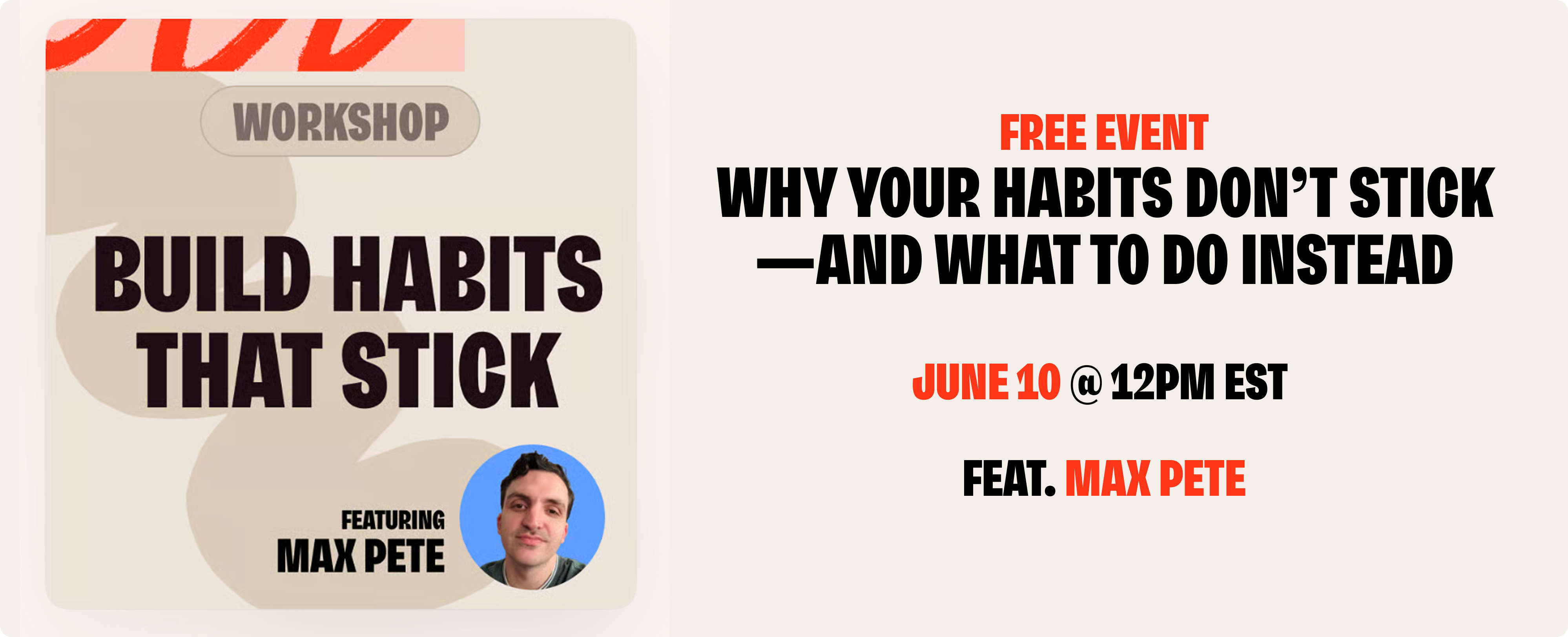
RSVP for our next free event with Max Pete
The real question: What’s cheap for you?
Anyway, I could not stop thinking about this. I wondered how I might go about discovering what sacrifices I, personally, am uniquely tolerant of and whether my dreams were “affordable” to me now, or if I needed to work on exchanging the currencies I have for others I need. (Or reevaluating if the costs are worth it!)
So, using Lowe’s posts as a starting point, I made a “checklist” of different currencies folks might already have in their bank accounts.
If you want to try this evaluation, you’re looking for statements that feel “cheap and easy to bear” to you—that’s how you know which currencies you’re rich in.
Still not sure? Try asking the following questions about each item:
Do I mind paying this cost?
Am I willing to pay this cost?
Does sacrificing this come easier to me than to other people?
What is energetically cheap for me, but seems expensive for others?
What costs can I pay sustainably over time?
Success currency checklist:
Time & effort currencies
I believe I find it easier than others to…
Give up my leisure time
Give up time with my loved ones
Restrict my ability to be spontaneous
Follow a very strict schedule
Put in long or grueling hours
Deal with bureaucracy/administrative overhead
Delay gratification for very long periods
Rely on intrinsic motivation to get things done (rather than external accountability)
Obsess deeply over one thing/practice dedicatedly without getting distracted
Financial & security currencies
I believe I find it easier than others to…
“Grind it out” with the promise of later payoff
Spend the money I have
Take big financial risks
Endure financial instability/inconsistency
Live with a lower standard of living than those around me
Bet on myself financially with no guarantees
Ask for money and/or negotiate aggressively
Relational currencies
I believe I find it easier than others to…
Miss important moments with loved ones
Accept outgrowing existing relationships
Give up or delay having a family
Lose proximity to family/community
Be lonely
Be emotionally available even when exhausted
Endure the vulnerability of being known by others
Survive without my support system
Network even when tired or introverted
Navigate conflict with those I love
Handle relational ambiguity or instability
Have to rely on others to get something done
Reputational currencies
I believe I find it easier than others to…
Accept public exposure/lack of privacy
Be unable to fully separate my work from my identity
Have my work/output criticized
Be publicly attacked or scrutinized
Be disliked or misunderstood
Be perceived as cringe, uncool, naive, or try-hard
Experiment publicly
Finish/launch something instead of making it “perfect”
Risk failure in public
Attach my name to unfinished ideas
Be visibly ambitious
Emotional & psychological currencies
I believe I find it easier than others to…
Endure emotional discomfort
Maintain emotional regulation in the face of strain
Practice mental discipline
Accept living with uncertainty
Navigate a new/foreign situation
Maintain conviction despite negative feedback
Be patient with slow progress
Tolerate a lack of structure
Tolerate an extremely strict structure
Wait or pause for indefinite periods
Sit with boredom
Stay optimistic through repeated setbacks
Have to rely only on myself to get something done
Identity & ego currencies
I believe I find it easier than others to…
Have a low status/unprestigious job
Have a boring or unstimulating job
Experience rejection
Express my true point of view
Not express my true point of view
Not have autonomy/creative autonomy
Be a beginner again
Repeatedly start over
Not be the smartest or most competent person in the room
Follow direction even when I disagree
Be the one ultimately responsible in high stakes situations
Change identities repeatedly across my life
(I’m sure there are many more—this is just the list/categories I came up with in 30 minutes!)
Bonus: Now repeat the exercise, this time asking yourself all the things you believe you can’t tolerate as well as others, or can’t tolerate—period.
Aligning goals and tolerances
Some people will gladly work 80-hour weeks, but cannot tolerate public criticism. Others will risk financial instability, but lose their ever-loving shit when they have to deal with bureaucratic processes. And you might find some people happy to toil away in obscurity forever if it means they get to have creative autonomy.
None of those people are “wrong” for their (in)tolerances. We’re all wired differently. And I think it’s less about saying what you can or can’t achieve and more about will you actually be happy, fulfilled, and able to sustain it when you get there.
The person who can’t tolerate public criticism can’t 80-hour-a-week-hustle their way to being happy about being a popular online content creator, because public criticism is inherent in the success condition. Similarly, someone who finds it unacceptable to give up their leisure time is going to find it really hard to power through the decade it’ll take to go back to medical school and become a surgeon. Not that they can’t, but will it simply be too expensive for them, the cost-benefits all out of whack?
Now, I don’t think Lowe is saying that your tolerances are your destiny. More like if you are able to be aware of them explicitly, this self-knowledge will help you make better decisions for yourself and work on the right things. (And we are all about self-knowledge for the sake of making better decisions!)
So then the question becomes: What are the things you absolutely must tolerate well in order to/once you become successful at [insert goal here]?
While some tolerances may come naturally to you, you can absolutely build tolerances over time.
For example: I’ve always been comfortable navigating new situations/environments—I think my brain is just wired to find unfamiliarity stimulating rather than intimidating. This has given me an edge in all kinds of situations, and made me more likely to succeed in them vs. someone who is made persistently uncomfortable with new things.
On the other hand, I went to a conservatory arts program, and I learned to tolerate public criticism of my creative work without making it an indictment of myself, because the environment was specifically designed to make that possible.
I’m sure you can look at your list above and roughly determine what tolerances are natural vs. learned, too.
So the real question isn’t: “What do I want, and what am I good at?” It’s more like: “What kind of pain, tradeoff, or uncertainty can I—and uniquely I—sustainably endure?”
That’s your differentiator, and, as Lowe might say, a surprising ticket to your success.
Over to you…
Forget your star sign…tell me your unique tolerances! What are you especially inured to, and what just wears you down? Are your current goals aligned with your tolerances? I wanna hear about it!
But wait! There’s more…
Wanna work with us?
If you need help with brand strategy and storytelling, fractional brand and marketing leadership, and bringing your brand strategy to life in impactful ways, send us an email at hello@aroundthebonfire.com to get in touch.
Wanna hang out in person?
We do in-person retreats! Our next one isn’t in the books yet, but you can sign up for the mailing list to find out when we have new ones to offer.
Wanna hang out online?
We’ve got a bunch of digital events on the calendar. We’d love to see you there.
As always, you can find us on LinkedIn, Instagram, and Threads.