Hi there! You’re reading the Bonfire newsletter from Kevan Lee & Shannon Deep. Each week, we highlight brand, marketing, and creative learnings from our experience as in-house marketers turned agency owners who think a lot about creativity, our relationship to work, and how all of that impacts our identities. We’ll also feature insights from our digital community of super smart folks (which you’re welcome to join).
Wishing you a great week!
Want to explore what creative work means to you?
Join us in France in April for our next retreat!


The freelance flowchart
At some point, almost everyone who works in marketing, design, content, product, or any creative or knowledge field asks the same question:
Should I go freelance?
Should I leave the in-house or agency grind and go do my own thing?
Will my own thing be any less grind-y?
Will it ever be as lucrative?
As you can see—and as you may know from personal experience—the original question of “should I go freelance” begets additional questions, which beget questions of their own. Going freelance is seldom an exercise taken lightly. But it is a path chosen by more and more of our peers, especially as the marketing and creative workforce changes so dramatically at modern businesses with their budget cuts, efficiency mandates, and AI everything.
(I’m using “going freelance” as a placeholder for any sort of new adventure you might take beyond a traditional, salaried role. For instance, we aren’t technically freelancers at Bonfire; we run our own business. But a lot of the same freelance ethos applies.)
Going freelance is a tempting thought.
It is also a complicated decision.
We don’t purport to have all the right answers, especially not all your right answers since every freelance path is unique. But having weighed these decisions over the years for ourselves and in talking with many, many startup friends, we have some ideas about what goes into the decision-making process.
So here is one way to think about the freelance decision. You can use these questions as a flowchart, giving you a little nudge down your path of deciding.
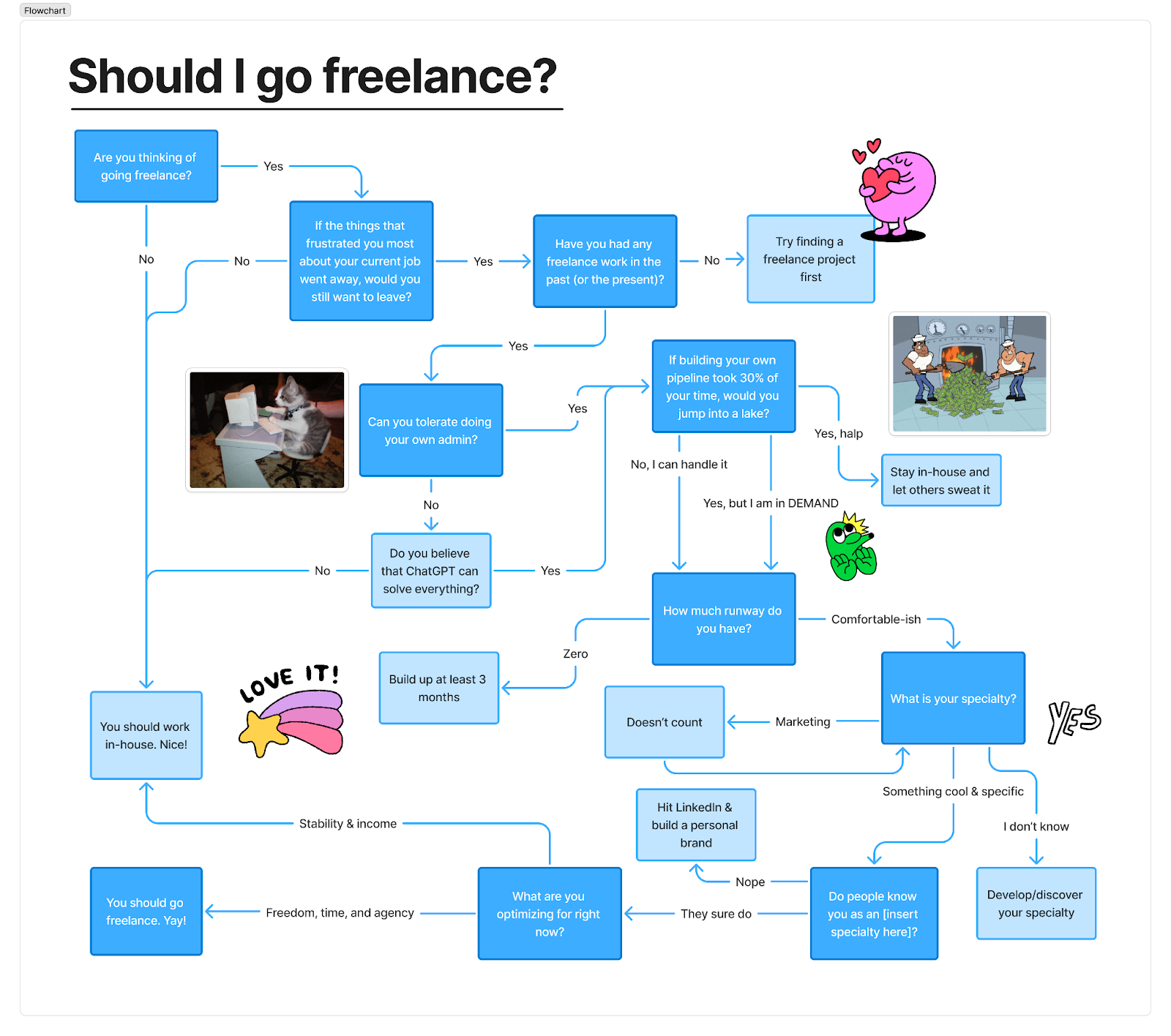
Step 1: Do you actually want to be freelance, or do you just want your current job to be better?
This is the first fork, and it is huge. Are you running from something or toward something? Sometimes the desire to freelance is really a desire for one of these things:
More control over your work
More flexible hours
Fair compensation
Less bureaucracy
Fewer meetings
Those are real desires and worth prioritizing if they’re important to you. Freelancing is but one way to get them. Before you quit anything, ask yourself: If my current job suddenly removed the one or two things that frustrate me most, would I still want to leave?
If the answer is no, then the move might be a role change, a team change, or a negotiation, not freelancing.
If the answer is yes, keep going.
Step 2: Do you already have proof that people will pay you?
The easiest freelance careers usually start like this:
Someone asks you to do a small project on the side.
That project goes well, so you do more projects.
Word gets around, and more people ask you to do projects.
You realize you have more demand for your skills than you have time in the day.
We had a couple potential projects before we made the full-time leap into Bonfire, and it helped ease our transition immensely. A good rule of thumb: Have at least one paying client or project before you decide anything dramatic.
Step 3: Do you like doing the work, or do you like having done the work?
Freelancing is not just you spending all day doing exactly the thing you love. Unless you also love bookkeeping and tool hygiene! Certainly there are some instances where freelancing gets you out of onerous meeting bloat, but there remains at least some slog on the other side of freelancing. You have to do your own admin, scoping, invoicing, follow-ups, payroll, HR, and deal with the low-grade uncertainty of not knowing whether you’ve done it all correctly.
Some people (me included, most days) love the feeling of independence more than the daily reality of running a small business.
When you’re thinking through this stage, there are two parts:
Process
Pipeline
Re: process, you the freelancer will be responsible for all admin tasks. Is that a complete nonstarter for you? It is for some people, and that’s totally fine. Realistically, you can expect admin work to take up to 20 percent of your time and energy. We’ve found it to be such a big hurdle for wannabe freelancers that we’ve considered building out part of our business to support just those who want to make the freelance jump. (If this is you, drop us an email!)
For pipeline, you also have the sole responsibility of bringing in new clients. You are CEO, Chief Revenue Officer, Sales Manager, and Account Executive. You are an outbound rep, as needed. You are the company spokesperson, when required. In our experience, the amount of time you spend on pipeline is very dependent on how you price your services and how much you want to be earning and working. In general, you can count on pipeline-building as another 30 percent of your time.
Twenty percent admin plus 30 percent pipeline means you have 50 percent left over for the craftwork you love to do.
If admin and pipeline don’t turn you off completely, then keep going.
Step 4: Do you have a runway?
Runway, in terms of this freelance flowchart, means the amount of time you can live without new income.
Freelancing income is rarely smooth at the beginning, and it definitely is not enough to replace your current salary right away (if ever!). Most new freelancers aim to have three to six months of living expenses saved away before they go solo, but this number varies from person to person.
Runway, of course, does not remove risk altogether. But it does take some pressure off of those first few months of freelancing.
Step 5: Are you comfortable being known for something specific?
Freelancers grow faster when their positioning is clear and unique. Specializing in “marketing,” is not really specializing. Instead, you might consider specializing in:
Lifecycle email for SaaS
Brand strategy for early-stage startups
Conversion copy for landing pages
As someone who loves doing all sorts of different things, specializing has been hard for me. Having a specialty means focusing and narrowing. It means building a personal brand around a particular topic and being comfortable going super deep on that topic over and over and over again.
Will you be comfortable with that?
If so, what might your specialty be? Here’s a good test: Ask yourself: If someone introduced me at a meetup, what would they say I am great at?
Step 6: What are you optimizing for right now?
We saved the best for last. This might be the most important question in the entire flowchart.
At different moments in life, different things matter most:
Stability
Learning
Freedom
Income
Time with family
Building something of your own
Freelancing is excellent for some of these and weaker for others.
Freelancing excels at:
Freedom
Time with family
Building something of your own
Full-time, salaried work tends to be better with:
Stability
Income
What’s most important to you right now?
Conclusion: Should you go freelance?
The good news: There is no wrong decision here.
As you can see, there are SO many factors that go into the freelance choice, and almost all of them will be unique to you and your situation. There is no wrong answer, and there is no hurry. Sometimes, going freelance can feel like you must act now or you must capture this once-in-a-lifetime moment, but turns out, the option to go freelance will always remain. If the conditions aren’t proper now, they might be in a few months or a few years.
If you do decide to go, let us know! We’d love to support you or answer any questions.
If you decide to stay at your current full-time gig, we’re big fans of that, too, and we’re here for any tricky questions or conversations you might need to have about creating the best possible workplace where you can thrive.
(See? No wrong answers. We’re here either way.)
If you’d like to spend time with some like-minded folks who are thinking through big questions just like these, we’d love to have you join our Campout community, our little online space where people navigate careers together.
Wanna hang out in person?
New retreat dates are up! Head to our experiences page to join our next one in April 2026.
Wanna work with us?
If you need help with brand strategy and storytelling, fractional brand and marketing leadership, and bringing your brand strategy to life in impactful ways, send us an email at hello@aroundthebonfire.com to get in touch.
As always, you can find us on LinkedIn, Instagram, and Threads.