

Want more time in 2026?
Here's how to create it—or at least, feel that way!

Hi there! You’re reading the Bonfire newsletter from Kevan Lee & Shannon Deep. Each week, we highlight learnings from our experience as in-house marketers turned agency owners who think a lot about creativity, our relationship to work, and how all of that impacts our identities. We’ll also feature insights from our digital community of super smart folks (which you’re welcome to join).
Wishing you a great week!
I’m not a Doctor Who fangirl, and I can’t even claim to have seen a single episode. But, as our culture is wont to do these days with popular properties, bits of Doctor Who have become atomized into the web-o-sphere and I’ve picked up a few things by osmosis. One of which is the Doctor’s description of time:
“People assume that time is a strict progression of cause to effect. But actually, from a non-linear, non-subjective viewpoint, it’s more like a big ball of wibbly-wobbly, timey-wimey…stuff.”
Mmm, yes. Very clear.
But actually, let’s think about that for a second, because buried in this humorous quote are some rather uncomfortable truths about time: namely, that for humans it isn’t, like, a quantitative thing. Even though we’ve almost all agreed, as a species, to measure time in 24-hour days of 60-minute hours of 60-second minutes, we don’t actually experience time passing like that. We don’t carry an innate sense of an hour or a minute in our brains or bodies. We need clocks to keep track of the time, and time often surprises us with how much or how little has passed, doesn’t it?
A rock, on the other hand, has properties like mass, length, width, height, texture. The material has a certain hardness you can feel when you knock on it and a weight when you heft it. A hundred people could hold the same rock, and you’re not going to hear that some of them thought the rock was very small and soft and others thought it was absolutely huge and hard and heavy and that some people didn’t even realize you had given them a rock at all and others were crushed by it.
But we do talk that way about time.
An afternoon will drag on, feeling seemingly endless for someone, but zip by in an instant for another person. We can’t believe it’s already 2026, or we spent 2025 wondering if this year would ever end. We’re stunned that our babies are already going to kindergarten when it feels like just yesterday they were in diapers, but at the same time we feel like we’ve known a person forever, but it’s only been a year.
In all of those scenarios, we can correctly identify the amount of time that has actually passed. (No one would insist that their kindergartener was actually born yesterday.) But our felt sense is the dominant human experience of time, not its objective measure.
There are all kinds of reasons why this is or might be true, and those things involve understanding time as the 4th dimension of our reality, delving into the fundamental properties of human consciousness, and a bunch of other things that I don’t feel entirely qualified to explain (but love reading about).
But what I can say, definitively, is that our perceptions of time are individual and subjective, and while we can’t literally “create more time,” we absolutely can create the feeling of having more time! (Which is, when you think about it, the exact same thing!)
The science of time creation
Our perception of time has to do with sensory—and therefore memory—density, meaning how richly experienced and remembered our lives are. And that density is a product of novelty and attention. New and unfamiliar experiences tell our brains to perk up, and that attention encodes richer and deeper tapestries in our minds, leading to a feeling of time dilation. This is why you often have memory holes for things you do habitually—your commute, brushing your teeth, your dog’s morning routine—and why hours can pass in a blink when you’re sucked into the monotonous scroll of your phone.
So if you want to create more time in 2026, you have to create more novelty and attention. That doesn’t mean you have to go on an exotic vacation every month (though if you can, more power to ya!). Rather, it means identifying small, daily ways to incorporate newness and to practice presence. And the time will follow!
Here are some tried and true ways to up your novelty factor and boost attention in 2026:
1. Design one “novelty anchor” per week
Not a big life change, but a small, specific interruption to pattern. Think of one premeditated deviation each week and treat it as non-negotiable. Some examples:
Take a different route to a routine destination
Cook a cuisine you’ve never made before or something that involves a new recipe
Work from a café you’ve never been to or just change up your usual coffee shop
These little changes work because our brains need contrast to encode memory. One distinct anchor per week will help prevent the weeks from collapsing into a blur—without creating decision fatigue or feeling like a major chore or time investment.
2. Purposely slow down one daily activity
This is about attention density, not efficiency. Choose one recurring, totally mundane activity and deliberately do it at half speed—or as slow as you can make it! I’m talking about things like:
Drinking your first coffee. Just sit and sip. Pay attention to the temperature of the coffee, the physical sensation of liquid passing over your lips and tongue, what it feels like to swallow. Are there patterns in bubbles or foam on the top? What about steam rising? How heavy is the mug in your hands? How strong is the smell? Etc.
Showering. This one is great because of the amount of sensory input all over your body! Temperature, water pressure, the feeling of soap on your skin, shampoo in your hair, what your hair feels like when wet, the scents of all your different products, any tight muscles that feel good under hot water.
Walking the dog/taking a walk. Probably, you’re walking in a very familiar place, like your immediate neighborhood. Really look at all the houses and buildings around you. Notice their colors, what materials they’re made of, how many stories they are. Can you see other people through the windows? How many different kinds of trees or plants can you spot? Do you hear nature, cars, people’s activity? Any smells wafting out to you? What’s the ground like under your feet?
With all of the above or with whatever activities you can think of that fit this bill, the key is NO MULTITASKING!!! No optimization. No screens, no music, no podcasts. No calling your sister to catch up. No escaping into your own fantasies or worries. Just awareness of the physical world around you.
This works because time expands when attention increases. You’re not adding time; you’re like…thickening it. If you feel faintly uncomfortable or impatient, you’re doing it right!
3. Try for “firsts,” not goals
Or, if you’re someone who just has to have a goal, make it your goal to have “firsts”!
Pick a few things every month you’ve never done before. It could be relatively simple like a new recipe, getting into a new hobby like journaling or painting, talking to the regular barista at your coffee shop for the first time, checking out a new restaurant, a new class of some kind… Anything that you’ve never done before, try it!
The first time you do something, it produces disproportionate memory density. Repetition is what flattens and speeds up time, and firsts stretch it. Measure success by “Did I do something unfamiliar?” not “Did I stick with it?” (Refreshing, no?)
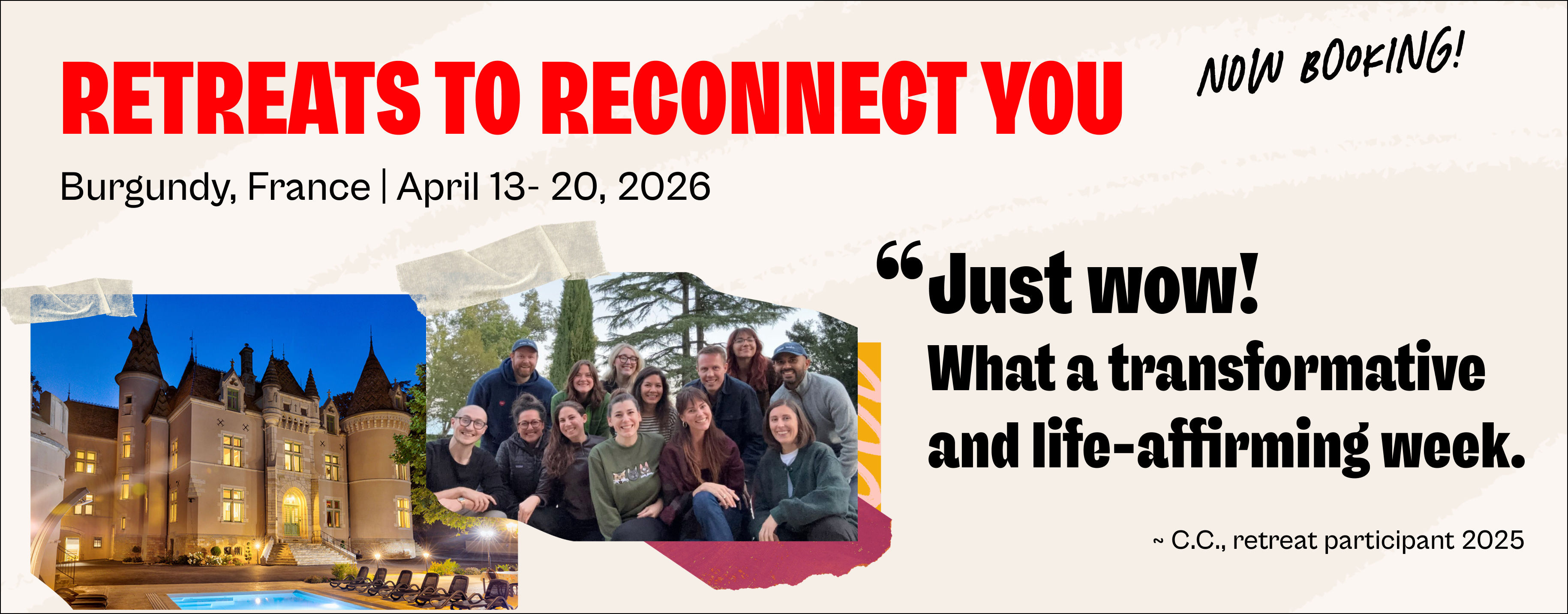
Join us in France for The Soft Reset, and reconnect with your vision and purpose. Spots limited!
4. Build some temporal landmarks
Without landmarks and milestones, days collapse into weeks which collapse into months. But with temporal markers, time stacks.
Create a regular cadence of “landmarks.” Maybe it’s once a month, or maybe it’s just every quarter or a “half year check in.” Think of a ritual you could do, maybe a solo excursion, a letter to yourself, a reflective journaling moment, or even just a very intentional walk. This is even something you could do as a family or in a small group of friends and share your reflections!
During this time, you’re going to think about all the things you’ve lived through, accomplished, or started over the previous period. It’ll help to write them down or record yourself talking. When you get to the end of your ritual, you could even “open” the next period/season with an intention, wish, or goal. The point is to spend time consciously acknowledging the time that has passed and what filled that time.
Landmarks like these break the year into psychologically distinct segments, making it feel longer in hindsight. You’re reinforcing the memories of what you did, encoding them so they stick better.
5. Reduce passive novelty
Sorry. You probably knew this one was coming! Scrolling delivers constant stimulus but low memory encoding. It feels stimulating and absorbing in the moment and empty in retrospect. This is passive novelty. You want active novelty!
The easiest ways to make sure that what you’re doing is active vs. passive are:
Don’t involve a screen.
Do something rather than consume something.
Do one thing instead of multitasking.
Involve your body, not just your mind.
Extend your consciousness to what’s around you, not just what’s going on in your head.
Net-net: Your brain remembers what you participate in, not what passes through you. If you want time to slow down, stop “outsourcing” experiences by consuming them passively!
In all 5 of the above tips, the underlying principle is that you’re not hacking time; you’re hacking memory formation. A day, month, year feels long or short in retrospect, based on how richly it was encoded. The equation is: Novelty + attention = denser memory = longer felt time.
Which brings us back to the core idea buried in that quote from Doctor Who:
Time isn’t something that happens to us, outside of us. It’s something we experience—and experience is malleable.
Over to you…
What commonalities have you noticed about when a day or period of time feels long or short? Is it something you consciously try to manipulate? We’d love to hear about it!
But wait! There’s more…
Wanna hang out in person?
New retreat dates are up! Head to our experiences page to join our next one in April 2026.
Wanna be friends?
If you love this newsletter and wish it were more interactive, you’re in luck! Join us over in Campout, our digital community for creative marketers and the creative curious.
Wanna work with us?
If you need help with brand strategy and storytelling, fractional brand and marketing leadership, and bringing your brand strategy to life in impactful ways, send us an email at hello@aroundthebonfire.com to get in touch.
As always, you can find us on LinkedIn, Instagram, and Threads.