

Disagreeing with Rick Rubin
The limits of audience-first thinking

Hi there! You’re reading the Bonfire newsletter from Kevan Lee & Shannon Deep. We’re hosting a free event on June 10 all about healthy habits, featuring the amazing Max Pete. We’d love to see you there.
Wishing you a great week!

Rick Rubin is one of the most influential music producers of the last 40 years, having worked with everyone from Jay-Z and the Beastie Boys to Red Hot Chili Peppers and Johnny Cash. He co-founded Def Jam. He helped shape the sound of multiple genres. He has a reputation not just as a producer, but as a kind of creative philosopher. A creative philosopher with a big gnarly white beard. He literally wrote the book on creativity: The Creative Act.
So when Rick Rubin talks about creativity and influence, people listen.
And sometimes, like in this exchange from a 60 Minutes interview, the reaction is, “Huh??”
Rick Rubin: “The audience comes last.”
Anderson Cooper, confused: “How can that be?”
Rick Rubin: “The audience doesn’t know what they want. The audience only knows what has come before.”
 Tiktok failed to load.
Enable 3rd party cookies or use another browser
Thank you to Anderson Cooper for asking the question we were all thinking. The audience comes last? For real?

For marketers, this is close to heresy. The audience is supposed to come first. We build personas. We interview customers. We read reviews. We analyze search behavior. We test and test and test until there’s no testing left to do.
And yet Rubin’s point is hard to dismiss because it also feels obviously true.
The audience does not always know what it wants before it exists. Case in point: the oft-attributed Henry Ford quote, “If I had asked people what they wanted, they would have said faster horses.” In Rick Rubin’s experience with music, the audience could not have asked for hip-hop to cross into the mainstream in exactly the way Def Jam helped make possible. They could not have asked for Johnny Cash to become a late-career icon through covers of songs by Nine Inch Nails and Soundgarden. They could not have asked for the next new thing because, by definition, the next new thing is not yet available to request.
In good times, audience-first thinking can make work clearer, more useful, and more relatable.
In bad times, audience-first thinking can also make work predictable, overfit, and dead.
Rick Rubin is right. Sometimes.
But the audience debate is quite a bit more nuanced. No, the audience should not always come last. But the audience probably should not come first in the way we tend to lionize it.
Here’s a different way to think about audience in relation to your creative work. I hope that Rick Rubin would agree!
“Audience” contains multitudes
One reason the “audience comes last” idea feels both right and wrong is that we use the word “audience” too broadly.
There are dozens of different contexts in which audience gets used as a catchall. Here are the top three contexts that I’ve most often experienced in my creative work, whether on the job or in a project:
The imagined audience: The voices in your head judging everything before it exists.
The real audience: Actual people with actual needs, fears, hopes, habits, and context.
The future audience: People who will only understand the work after it exists.
Most watered-down creative thinking comes from obeying the imagined audience.
Most good marketing comes from understanding the real audience.
Most great creative work is made for the future audience.
The imagined audience is usually the most dangerous. This is the audience that makes you hedge on your creative output in order to appease these imagined others. It is the invisible committee in your head saying, “People will think this is too much,” or “Someone has already said this,” or “What if this makes us look (gasp!) weird?”
A lot of bad audience thinking comes from obeying this group.
The real audience is different. The real audience is made of actual people. They have problems, preferences, objections, timelines, anxieties, and jobs to be done. In marketing, ignoring the real audience isn’t really an option if you want to be effective with your work. Good marketing comes from understanding the real audience.
Then there is the future audience. This is the audience that Rick Rubin is talking about, the audience that does not know what it wants because it has only seen what has come before. The future audience is the group that will understand the thing once someone has made it. They cannot brief you on the work, but they can recognize it when it arrives.
A lot of great creative work is made for the future audience.
So the real question is not, “Does the audience matter?”
The better question is, “Which audience are you listening to, and what power are you giving them?”
Do they want it, or does it resonate?
We often ask questions that sound audience-centered but are actually too literal.
Would you want this?
Would you click this?
Would you buy this?
Would you share this?
Which concept do you prefer?
These questions can be useful in the right context, but they can also flatten the work. People are not always good at predicting their own future behavior. They may prefer the safest option in a test and then ignore it in real life. They may clamor for a product in an interview and then not pay for the thing when it’s available.
This is why “What do you want?” is often less useful than “What resonates?”
Resonance is different from preference. Preference is often conscious and comparative. Resonance is deeper. Something resonates when it makes a person feel seen or challenged or relieved or delighted.
A simple audience-resonance matrix
One way to make this practical is to separate two questions that often get collapsed into one.
Does the audience matter?
Does resonance matter?
Though the questions may sound similar, they contain distinct qualities and they can steer you in different directions. It’s perhaps easiest to see in the form of a matrix.
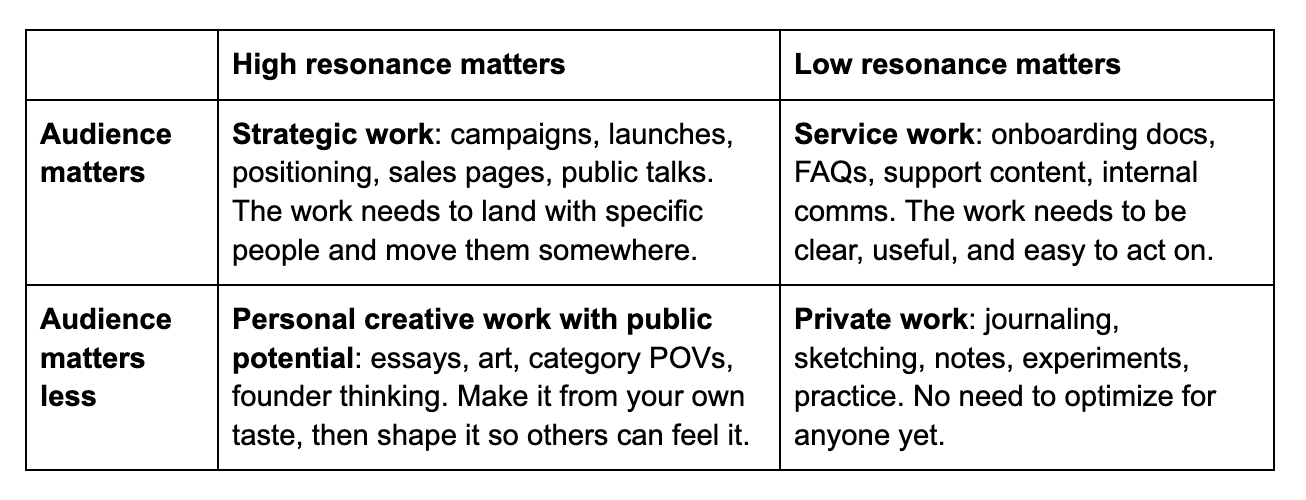
High resonance and audience both matter for …
Strategic work: campaigns, launches, positioning, sales pages, public talks. The work needs to land with specific people and move them somewhere.
Low resonance and audience both matter for …
Service work: onboarding docs, FAQs, support content, internal comms. The work needs to be clear, useful, and easy to act on.
Audience matters less, but high resonance still matters for …
Personal creative work with public potential: essays, art, category POVs, founder thinking. Make it from your own taste, then shape it so others can feel it.
Audience matters less, and low resonance matters for …
Private work: journaling, sketching, notes, experiments, practice. No need to optimize for anyone yet.
Each of these quadrants you may find relevant at different points in time in your creative work or your work-work.
The Rick Rubin quadrant, the one he’s referring to when he says the audience comes last, is the bottom left: audience matters less, resonance matters more. That is where a lot of creative work lives.
Audience should matter more when the work is asking something of people.
If you want someone to buy, sign up, donate, attend, reply, trust you, change behavior, or make a decision, you owe them consideration. The audience is not an inconvenience to your expression. They are the people the work is trying to reach.
Audience should also matter more when the stakes are high or the work is functional. Healthcare, finance, legal, safety, security, onboarding, documentation, pricing, product UX: these are not the places to be coy. If someone has low context, the job is to build the bridge.
But audience should matter less when the idea is still forming.
Audience should matter less when you are building taste, developing a point of view, or trying to say something true. The audience can help you find friction, but it cannot always give you vision.
Conclusion: 4 questions to ask yourself
When you’re evaluating audience’s role in your next creative project or your day-to-day work, here’s a short list of four questions that should help you decide where to start:
Who is this for? Not “what do they want?” But rather: who needs to be able to receive this?
What do they already believe? This tells you where the work begins.
What do you believe that they may not believe yet? This is the point of view for your work.
What must be preserved, even if it costs you some approval? This is the soul of the work.
Hopefully these questions can get you on track for how to get started with your project and how to make sense of the Rick Rubin voices in your head.
I was Typeform's first marketing hire. The first thing I learned from the founders—and, no, they didn't say it overtly—was that taste matters. They had real design taste. The product's growth was on the unicorn path (K-factor was 1.1, I believe). They didn't set that as a goal, they just wanted to build an interactive, engaging form. In a strange way they put the audience of their user's audience first—and their taste was the bar that the product had to clear—basically scratching their own itch. They didn't run focus groups, run surveys, etc. They were the opposite of data driven, they created data from building something so unique.
But growth doesn't sustain, does it? Eventually we did JTBD interviews, really tightened SEO work, and focused on the customer—after some time, we realized we didn't listen to customers enough.
Rick Rubin is both correct and incomplete and the music industry proves it. You either have supreme taste so it doesn't matter what you do as an artist—you test the bounds, you experiment with new sounds, and your "growth" might turn off old fans as a result. Or you get super formulaic, resort to "best practices" and your old audience grows old with you—building your audience incrementally over time (or not at all). Both moves represent your taste to the world.
But super innovative work diverges from the norm, and often that's driven by taste, or personal "resonance" (to use your term)—not an audience.