We all need somebody to lean on
Remedies for feeling alone on a team

Hi there! Want to hang out with us on Wednesday (May 20)? We’ve got a cool event we’re hosting. It’d be great to see you there!

Remedies for feeling alone on a team

Back in the day, when I was leading startup marketing teams, one of my favorite workplace surveys was the Gallup Q12 engagement survey, often referred to as the Strength of the Workplace survey. I would either run the survey as an every-six-months pulse check, or I would cherrypick questions to ask in 1:1s.
No other survey gave me the same at-a-glance insight into my team’s engagement.
Or lack thereof.
Mostly, my teams were engaged (if any former teammates are reading, feel free to agree/disagree in the comments). Nevertheless, the survey did a great job of identifying anyone who felt under-supported on the team. Honestly, if I were to have given the survey to myself back then, I probably would have been one of those who felt under-supported, too.
How would you do on the survey, today?
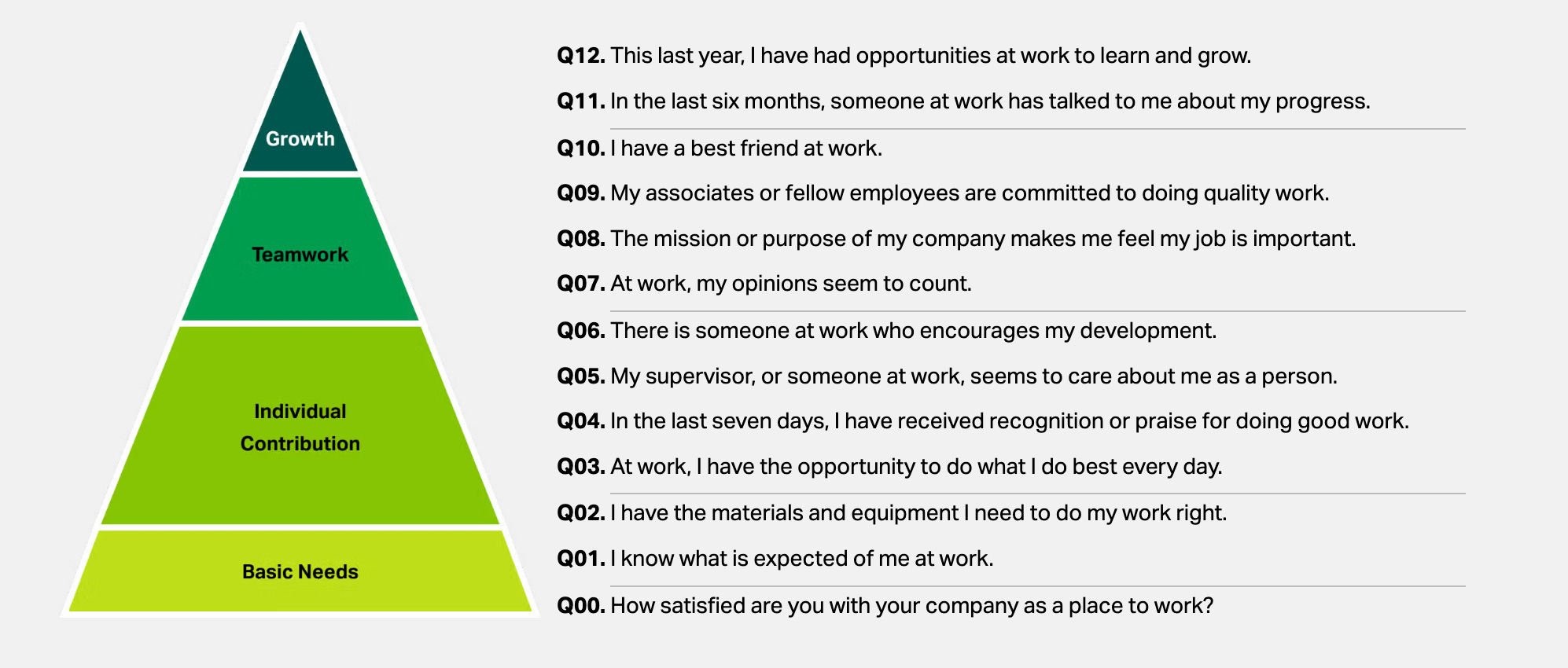
Here are the 12 questions:
Do you know what is expected of you at work?
Do you have the materials and equipment to do your work right?
At work, do you have the opportunity to do what you do best every day?
In the last seven days, have you received recognition or praise for doing good work?
Does your supervisor, or someone at work, seem to care about you as a person?
Is there someone at work who encourages your development?
At work, do your opinions seem to count?
Does the mission/purpose of your company make you feel your job is important?
Are your associates (fellow employees) committed to doing quality work?
Do you have a best friend at work?
In the last six months, has someone at work talked to you about your progress?
In the last year, have you had opportunities to learn and grow?
In a perfect world, you would be able to answer “yes” to as many questions as possible, ideally all 12. How many are a “yes” for you right now?
In times like these, I wouldn’t be surprised if there are more “no” answers than “yes” answers. Work is hard. Jobs are tough. To be a knowledge worker in 2026 is to be a cog in a machine with no off switch. On the macro level, this Gallup survey is checking to see how resilient a workplace really is. But on the personal level, I think this survey reveals something more meaningful to us individual people on the team:
Who is looking out for me? Where can I turn for support?
If this sounds like you, keep reading for some ideas.
Alone on a team, aka what every job feels like in 2026
Work has become more distributed, more tool-mediated, more asynchronous, and more efficient-at-all-costs. People are “connected” all day, but not necessarily supported. In fact, Gallup’s latest workplace report says we’ve reached pandemic-period levels of disengagement: only 20% of the global workforce reported feeling engaged at work, the lowest rate since 2020. One in five employees experience loneliness “a lot.”
This leads, of course, to disillusionment, to “shields down” moments, and to major job fatigue. SHRM, the world’s largest HR association, found that 44% of U.S. employees feel burned out, 45% feel emotionally drained, and 51% feel used up at the end of the workday.
It’s strange to hear these stats and then to notice all the effort that workplace products and systems place on collaboration and togetherness. What’s happening is that a lot of modern work has the texture of support without the substance of it. There are Slack channels, all-hands meetings, values decks, async updates, dashboards, rituals, check-ins, etc. But they end up feeling like a mirage when what people really crave is clarity, safety, and support.
Quite literally, this is how Gallup positions its Q12 survey questions, placing them into a Maslow’s hierarchy of needs chart, assigning questions to areas of basic needs, contribution, teamwork, and growth.
Modern work has become very good at creating the appearance of togetherness. It is way less good at making people feel genuinely supported. (In fact, the not-so-secret message of the AI-optimized workplace is that modern work may not even need you, a human being, at all.)
And unsupported work is hard no matter what kind of worker you are. Whether you are ambitious and striving, tired and detached, brand new and overwhelmed, senior and supposedly self-sufficient, or somewhere in between, it is deeply difficult to do good work when you are also responsible for creating all the conditions that make good work possible.
Who is actually paying attention to whether you are clear, equipped, valued, known, challenged, protected, and growing?
The archetypes of under-support
Under-support often shows up at transition points. The work changes (hello, AI systems!), the expectations rise, the context gets thinner, and suddenly you are expected to know how to operate in a role that no one has actually helped you inhabit.
You might recognize yourself here:
You were promoted from individual contributor to people manager, but no one taught you how to manage.
You report to a CEO or executive who is too busy to give you real direction.
You report to a boss who does not fully understand what you do, so you have to define, defend, and evaluate the work yourself.
You are brand new to leadership and quietly wondering whether everyone else got a manual you missed.
You are brand new to an industry, a market, or a company culture where everyone else seems to know the unwritten rules.
You are senior enough that people assume you are fine, even when what you really need is context, feedback, or someone to help you think.
In each case, the problem is not that you are incapable. It is that you are being asked to perform capability without enough support around you.
You are people-managing yourself
People-managing yourself is when you have to be your own:
manager
coach
career sponsor
therapist
strategist
advocate
motivator
feedback loop
recognition system
boundary setter
chief of staff
There is a particular exhaustion that comes from having to people-manage yourself. Sure, everyone needs to advocate for themselves at various points of their career, but … all the time? In all the ways? Nothankyou. This is where the exhaustion sets in. It is not just doing the work. It is creating the conditions that make the work possible, while also doing the work, while also convincing yourself that this is maturity, resilience, or leadership. (Hello, negative self-talk.)
No one gets a perfectly supportive workplace, but there is a difference between healthy self-leadership and chronic self-rescue. The answer is not to become even more self-sufficient. The answer is to notice which kind of support is missing, then look for the closest available source.
Where to find support
1. Manager support
Manager support is the most obvious form of support, and often the one that’s most clearly missing. A good manager helps create the conditions for good work. A bad manager—or an absentee manager—does the exact opposite.
If you do not have good manager support right now, start by making the invisible parts of your work visible. For instance, you can send a short weekly update with three sections: what I’m focused on, where I’m blocked, and what decisions I need. This gives your manager a low-friction way to help, but it also creates a record of your priorities, workload, and judgment.
You can also ask for support in smaller, more specific ways. Instead of “I need more feedback,” try: “Can you tell me which of these three priorities matters most this week?” or “Can you review this before Friday so I know whether I’m on the right track?” If your manager still does not engage, look for a second source of managerial support: a skip-level leader, a trusted cross-functional partner, or someone who has context on the work.
2. Peer support
If you can’t find support with your manager, then peers can help you sense-check what is happening and what to do about it. Find one or two people who can help you answer practical questions like: “Does this priority make sense?” “Am I reading this situation correctly?” “What would you do next?”
A simple way to build peer support is to create a tiny recurring ritual like a 20-minute weekly check-in with someone in a similar role. There is real power in having someone who can empathize and relate to what you’re going through—and help you out of your tough times.
3. Sponsor support
Sponsorship often starts with someone in your orbit who understands not only your strengths, but also your goals. Think of your sponsor like an advocate. A cheerleader with influence.
You can build sponsor support by identifying one or two senior people who already benefit from, depend on, or respect your work. Then give them useful context on what you’re up to and what you need. For example: “I wanted to share the outcome of this project because it connects to the goals you mentioned in the last planning meeting.” Or: “I’m interested in growing toward more strategic work this year. If you see opportunities where I could be useful, I’d love to be considered.”
4. Craft support
Here you have the more traditional external support roles like coaching and mentoring. (We provide coaching at Bonfire if you or anyone you know might be interested.) These will be the people who can help you feel more grounded and confident in your role by helping you get the necessary context you need about how the role works and how to be the best version of you in whatever environment you’re put into. Oftentimes, this form of support can either look like general mentorship or specific coaching about your craft. Either way works, and you may find that one is more valuable than the other at different points of your career.
5. Self-support
Self-support is not the same as self-rescue. Self-rescue says, “I guess I have to carry this alone.” Self-support says, “I am noticing the pattern early enough to ask for the right kind of help.”
A useful weekly check-in is: What am I carrying that should be shared? What decision am I making alone that needs input? What support have I been wishing for but not requesting clearly? Then you can turn one answer into a specific ask. Not “I need help,” but “I need 30 minutes to sort priorities,” or “I need someone to review this before it goes out,” or “I need clarity on what can drop.”
6. Community support
Community support comes from being around people who understand the broader shape of what you are experiencing, even if they are not inside your exact workplace. These might be professional communities, founder groups, leadership circles, alumni networks (school alumni or colleagues from previous jobs), creative communities, or even a few people you gather intentionally because you are all navigating similar questions.
The gift of community support is that it helps you stop over-personalizing your experience. When you are under-supported, it is easy to assume the problem is you: you are not resilient enough, not strategic enough, not clear enough, not senior enough, not good enough at managing up. You’re pretty great, actually, and it helps to have a community that can reinforce this and externalize that under-supported is more about systems than it is about you.
Getting the support you need
When you take the Gallup Q12 survey—either right now or in the future—you’ll likely end up with a mix of yes and no answers. For every “no,” ask yourself:
Who could be helping me with this?
Have I clearly asked for what I need?
Is this a temporary gap, or a structural reality?
What would change if this were supported?
What am I currently normalizing because I’m good at surviving it?
This practice can help you gain some insight on which type of support you need, how to get it, and what work might feel like when you do.
We’ll be cheering for you on this journey! Consider us a part of your community support system, or even a coach support if you need it (feel free to reach out).
But wait! There’s more…
Wanna work with us?
If you need help with brand strategy and storytelling, fractional brand and marketing leadership, and bringing your brand strategy to life in impactful ways, send us an email at hello@aroundthebonfire.com to get in touch.
Wanna hang out in person?
We do in-person retreats! Our next one isn’t in the books yet, but you can sign up for the mailing list to find out when we have new ones to offer.
Wanna hang out online?
We’ve got a bunch of digital events on the calendar. We’d love to see you there.
As always, you can find us on LinkedIn, Instagram, and Threads.